



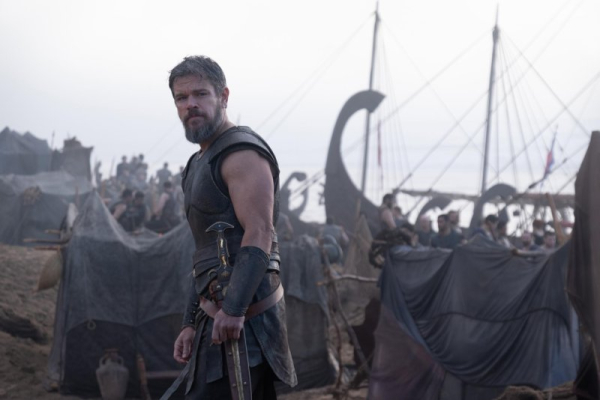
1 of 5 | Matt Damon plays Odysseus in “The Odyssey,” in theaters Friday. Photo courtesy of Universal Pictures
The Odyssey, in theaters Friday, is a cinematic epic worthy of Homer. Homer’s story was passed along in the oral tradition until it was written down, and Christopher Nolan’s adaptation can stand as the definitive portrayal in the visual era.
Odysseus (Matt Damon) has been away from Ithaca for 20 years since leaving for the Battle of Troy. His wife, Penelope (Anne Hathaway), has been holding off a home full of suitors awaiting his return.
Telemachus (Tom Holland), Odysseus’s son, sets out to Sparta to find word of Odysseus.
Like many of Nolan’s movies, his adaptation of The Odyssey, which he also wrote, bends time to tell its story. Penelope tells stories from before Odysseus left and Menelaus (Jon Bernthal) tells Telemachus the story of the Trojan Horse from the perspective of the men inside it.
The film finds Odysseus with Calypso (Charlize Theron), eating Lotus flowers to forget his journey. As the lotus wears off, he remembers his own adventures.
Mythological elements are subtle at first. The Gods are in people’s lives, as they follow Zeus’s Law to be kind to beggars just in case it’s really a God in disguise (not, however, simply because it’s the right thing to do). Agamemnon sacrificed his daughter to the Gods.
The Cyclops is a bona fide monster, as are other creatures appear later. When Circe (Samantha Morton) turns Odysseus’s men into animals, she physically molds them on screen with impeccable magical realism.
Athena (Zendaya) visits Odysseus in visions, and his men believe their hardships are a curse Odysseus incurred from Poseidon. That means any storm is seen as Poseidon’s wrath.
Those mythological encounters are realized with exquisite dramatic buildup. The Cyclops is first only seen by his giant hand, and then illuminated by Odysseus’s campfire.
It still takes strategy to escape the Cyclops’ cave. Another creature is so large it is difficult to even see what it is on an IMAX screen.
The soldiers question Odysseus and then get themselves into more trouble. Odysseus proves his leadership over and over without condescending or bullying.
The modern language is formal enough to seem “Greek” if not Homeric, assuming even our modern translations capture Homer’s authentic language. The omission of slang goes a long way.
However, it is straightforward enough to generate a deadpan humor. A soldier asks Odysseus if they should try reasoning with the Cyclops. His response, “I think we’re past that,” isn’t a one-liner per se but it illustrates Odysseus’s cool in the face of danger.
Usually when movies film sequences in IMAX, those chosen scenes envelop the viewer more than others. With every scene for nearly three hours in full IMAX, there are no smaller scenes for comparison and yet Nolan and cinematographer Hoyte van Hoytema never lose the grandeur.
Vast oceans and beaches, castle walls and interior halls, even the crowded insides of the Trojan Horse give the audience bearings to sense the scale. And the Trojan Horse towers above Troy in IMAX, as well the city gates when Odysseus opens them from the inside.
More than the cameras, what gives The Odyssey its scope is that Nolan’s production filmed on location. In Los Angeles, Italy, Morocco, Scotland, Greece and Iceland, every sequence feels tangible.
So when you’re watching Troy burn or the hostile seas, it never feels artificial or simulated.
The action and drama are permeated with a subtle score that is more of a pulse. Composer Ludwig Göransson, whose Oppenheimer score operatically directed the drama, just lets it build in The Odyssey. Even the Siren song is only a subtle change in notes.
There are moments where the music and sound combined drown out some dialogue. Suitor Antinous (Robert Pattinson) in particular gets drowned out in the climax, but in this case it’s a reaction the viewer can still discern, as opposed to important plot points going unheard.
The Odyssey fulfills its promise as the movie event of the summer. Nolan presents the grandeur of the Greek myth in impressive, engaging form.
Fred Topel, who attended film school at Ithaca College, is a UPI entertainment writer based in Los Angeles. He has been a professional film critic since 1999, a Rotten Tomatoes critic since 2001, and a member of the Television Critics Association since 2012 and the Critics Choice Association since 2023. Read more of his work in Entertainment.
