



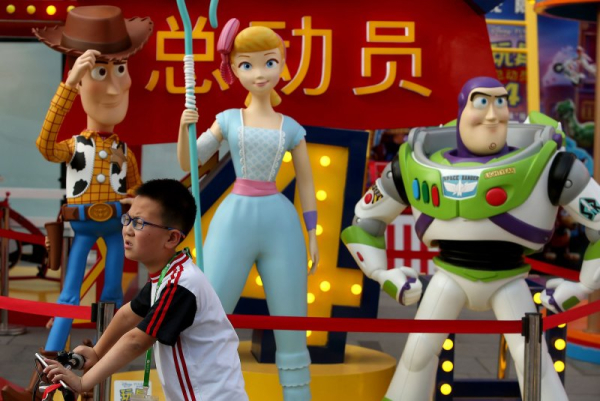
1 of 6 | From left, Woody, Bo Peep and Buzz Lightyear were on display in China for “Toy Story 4.” File Photo By Stephen Shaver/UPI | License Photo
The original Toy Story (1995) introduced a simple premise: Your toys are never where you left them because they’re actually alive and have their own adventures until you find them again.
Through five films, four streaming on Disney+ and Toy Story 5 in theaters Friday, the Toy Story movies entertained children with their beautifully animated depictions of playtime and friendships between different toys.
It was adults, however, who were more likely to have emotional breakdowns over the films’ depiction of milestone life events they’d already lived through.
From existential crises to concerns about the pervasiveness of tech, the Toy Story movies have resonated with adult audiences throughout the years due to their timely themes.
Note: This article contains spoilers for the first four Toy Story films.
‘Toy Story’ established the identity
The first Toy Story established a point that would become the thesis of the entire series. Pixar couldn’t have known that in 1995. They were just trying to prove you could make a 90-minute film with computer animation.
Buzz Lightyear (voice of Tim Allen) arrives in Andy’s (John Morris) room believing he is a real Space Ranger. Cowboy Woody (Tom Hanks) spends the movie trying to convince Buzz he is a toy. The line “You are a toy” is inseparable from Hanks’ voice.
After an identity crisis, Buzz accepts that he is a toy and this becomes what all the toys are dealing with. It reverses in Toy Story 2 when Buzz has to remind Woody that being a toy is more important than being a collectible. Toy Story 4 makes it even harder to convince Forky (Tony Hale) that he is a toy and Toy Story 5 even deals with the value of toys over tech.
‘Toy Story 2’ as the existential crisis
In the first and best sequel, Al (Wayne Knight) steals Woody to complete his “Woody’s Roundup” collection and sell it to a museum. Woody meets Jessie the cowgirl (Joan Cusack), the horse Bullseye and the Prospector (Kelsey Grammer). The potential of being in a toy museum tempts the toys with immortality and Woody is sold at first.
Jessie shares what has become the saddest and most important moment of the series. She tells the story, via Sarah McLachlan singing “When She Loved Me,” of her owner, Emily, who eventually became a teenager and donated Jessie.
This is the natural lifecycle. Kids grow up. Passing their toys along to the next generation is wonderful. The thing is, toys don’t grow up. And even a cynical adult can reflect on the toys they played with that shaped the people they became.
This is where Toy Story 2 became emotionally devastating for adults. Sequels would find other psychological wounds to pick at, too.
Woody ultimately accepts that being a child’s toy is finite, but it is more rewarding than living forever behind a glass case never interacting with children.
‘Toy Story 3’ confronts reality
Eleven years later, Toy Story 3 has Andy (still Morris) going off to college. The toys had mentally prepared for this moment, but they sort of try the museum thing again.
This time they go to a day care where they posit that they’ll get played with forever by a new class of kids every year. Day care isn’t all it’s cracked up to be as kids treat communal toys carelessly.
In the end, Andy gives the toys to Bonnie (Emily Hahn) to continue the series, but along the way, Toy Story 3 arguably contradicts itself.
The villain, Lotso Huggin Bear (Ned Beatty) is angry because his child replaced him, but that’s not the whole story. Lotso’s child lost her bear, so her parents bought another Lotso.
She still loved Lotso. That’s totally different than Jessie getting outgrown, or even The Prospector, who never got played with because he was a collectible in an unopened box.
It would have been interesting to explore what it means when beloved toys are replaced by copies of themselves. If it’s about the child, Lotso should be happy she has another Lotso. Buzz confronted other Buzzes in Toy Story 2 and will again in 5. Alas, Toy Story 3 doesn’t go there.
It does touch on end-of-life briefly when the toys end up on an incinerator conveyor belt at the landfill. That they are willing to face the end together seems beside the point with inanimate objects, no matter how anthropomorphized they are. Actually, Lost Ollie on Netflix dealt with the impermanence of toys in more depth.
Outliving childhood is far more tragic than simply being destroyed. As Highlander asked, “Who wants to live forever when love must die?” Besides, even before they made Toy Story 4 and Toy Story 5, grown-ups had to know that wasn’t how Toy Story 3 was going to end.
‘Toy Story 4’ shows any object can be emotional
Toy Story 4 answers the Lotso question, indirectly at least. Bonnie (now Madeleine McGraw) creates Forky in a Kindergarten craft project. When she loses him, her parents suggest she can make another Forky and Bonnie refuses.
It has to be that Forky. That’s the one she made on her first day of Kindergarten. She says, “There’s only one Forky” suggesting that some kids do identify with their specific object.
We only have Lotso’s perspective in Toy Story 3. Lotso’s kid probably never knew he was missing if her parents replaced him fast enough.
Forky’s insistence that he is trash could be a nature vs. nurture argument. He’s made from a plastic Spork and believes his destiny is to be thrown out after use. All the love from Bonnie and Woody’s micromanaging struggle to override Forky’s nature, and he remains in the cast of Toy Story 5.
In a flashback to nine years prior, Bo Peep (Annie Potts) knows it is time for the next kid. She made peace with it long before Andy went to college.
Woody still spends Toy Story 4 trying to relive his time with Andy through Bonnie. In the end, he realizes someone else was her Woody and that’s OK. Buzz assures him, “Bonnie will be OK.”
Still, it shows the reality of the aftermath of 1-3. Woody never totally got over Andy growing up, which is normal. Acceptance doesn’t mean we have no emotions about it.
One thing Toy Story has yet to reckon with is adults who still play with nostalgic toys. Not like Al with collectibles, but really still play.
That might not be so relevant to kids, but it seems to be where all this is going. Outgrowing our childhoods can hurt, but if we don’t, we might miss out on other rewarding experiences in life.
A look at the voice cast of ‘Toy Story 5’
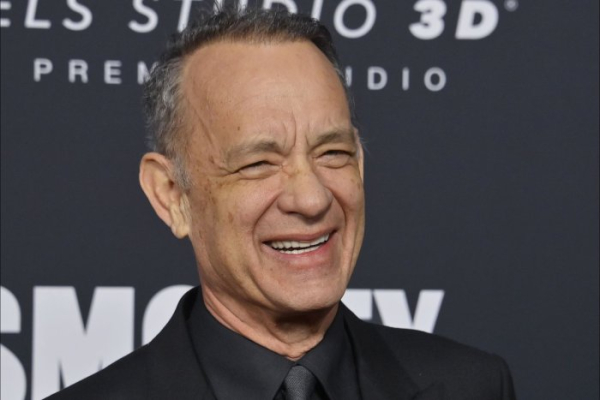
Tom Hanks – WoodyTom Hanks attends the MusiCares Persons of the Year gala in Los Angeles on February 3, 2023. Hanks portrays Woody. Photo by Jim Ruymen/UPI | License Photo
