


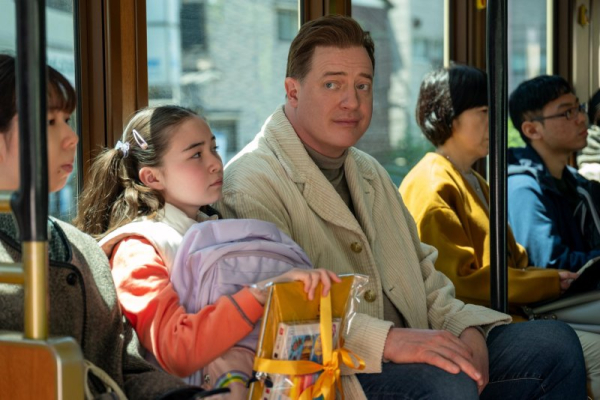
1 of 6 | Phillip (Brendan Fraser) plays father to Mia (Shannon Gorman) in “Rental Family,” in theaters Friday. Photo courtesy of Searchlight Pictures
Rental Family, in theaters Friday, dramatizes a unique service found in Japan into a story with universal relevance. As star, Brendan Fraser brings sincerity to the delicate balance of tear-jerker and morality play.
Fraser plays Phillip VanderPloeg, an actor who moved to Japan seven years ago for work. Now, he’s desperate for whatever day gig is available.
Phillip ends up taking a job from Shinji (Takeshiro Hira), who runs a Rental Family service. People hire a Rental Family actor to play a particular role in their lives, so Phillip has to memorize a character and sometimes lines to perform with real people.
Phillip understandably objects at first, feeling the job is manipulating other human beings. But, Shinji convinces him that it is fulfilling a need for consenting parties.
One of Phillip’s jobs is to play a husband for a bride (Misato Morita) whose parents do not approve of her actual marriage. The film does not interrogate whether the service gives homophobic parents a pass, but focuses instead on how the ruse gives the bride freedom without cutting off her family.
Even trickier is an assignment in which a single mother (Shino Shinozaki) hires Phillip to play her daughter’s long-lost father for a school administration interview. The school discriminates against single mothers.
However, the mother does not inform her daughter, Mia (Shannon Gorman), that she’s hiring an actor and furthermore instructs Phillip to convince Mia he is her father.
Phillip objects to deceiving a child but is convinced to go along with the client because the school will be good for Mia. Of course, not only does Mia become attached, but Phillip becomes committed to being a father figure.
This subplot speaks to the ways in which parents of any nationality try to micromanage their children’s feelings. It’s futile because sentient human beings will not fit in a box.
Mia is smart enough to ask questions, but the real X-factor comes when Mia exchanges phone numbers with Phillip. He essentially ends up working overtime during his off hours to maintain the relationship, but his motivation is kindness to support a child seeking connection.
The relationship can only end in emotional hurt, though, as the mother inevitably cancels the service after the interview with the school. Audiences can debate whether any school is good enough to warrant retraumatizing a child already abandoned once by a father.
Fraser has always been an actor who can bring sincerity to cinematic situations, whether it be acting opposite CGI in The Mummy or Looney Tunes, playing a cartoon character himself in George of the Jungle or facing anti-Semitism in School Ties or befriending a homeless man in With Honors.
Here, like his Oscar-winning turn in The Whale, he plays Phillip as a man open to, even desperate for connections, and guilt-ridden about relatively harmless lies. For example, playing a reporter so retired actor Kikuo Hasegawa (Akira Emoto) thinks someone is still doing a story on him, probably won’t harm anyone.
For an actor in Phillip’s situation, the jobs are more unpredictable than improv. Even improv is performing with a consenting scene partner, while Rental Family is playing a character and improvising with real human beings in the real world.
The business of rental families also bears similarities to artificial intelligence, though the practice itself predates technology. Clients are hiring human beings but giving them specific instructions to perform a scenario you want to live.
It’s like The Matrix. They can be 100% accurate but it’s still not real.
Veteran Rental Family actor Aiko (Mari Yamamoto) plays roles that put her at physical risk, which Phillip questions. Even barring bodily harm, the film astutely demonstrates that a simulation gets old and will never ultimately fill the void the client is seeking to satisfy.
Films about artificial paradigms historically come to the same conclusion. In Can’t Buy Me Love, paying to date the popular girl worked for a moment but the protagonist (Patrick Dempsey) was ultimately forced to be himself.
Phillip comes down on the side of condemning the rental family practice, and perhaps director Hikari, co-writing with Stephen Blahut, also has some qualified condemnation. The film ultimately settles on taking a more responsible approach to which services it will authorize, without ending the practice completely.
Fred Topel, who attended film school at Ithaca College, is a UPI entertainment writer based in Los Angeles. He has been a professional film critic since 1999, a Rotten Tomatoes critic since 2001, and a member of the Television Critics Association since 2012 and the Critics Choice Association since 2023. Read more of his work in Entertainment.
