


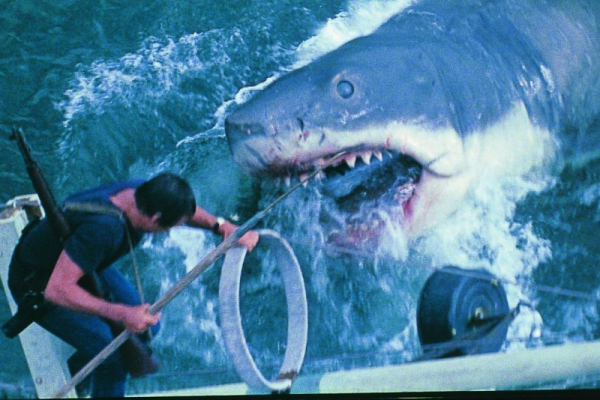
1 of 5 | Brody (Roy Scheider) faces the shark in “Jaws,” returning to theaters Friday. Photo courtesy of Universal Pictures and Amblin Entertainment
Jaws is credited with inventing the modern blockbuster, which has defined summers for 50 years. Returning to theaters Friday, the movie exemplifies the ideal to which new tentpole films should aspire.
Based on Peter Benchley’s best-selling novel, Jaws shows how a local story can become universal. The film centers on a great white shark terrorizing the coast of Amity Island in New England, which becomes apocalyptic for the residents.
When the shark attacks begin, Chief Brody (Roy Scheider) wants to close the beaches for public safety, but Mayor Vaughn (Murray Hamilton) won’t allow it in the interest of the summer tourist business. Subsequent attacks only make matters worse and bring a madhouse to town, with weekend warrior hunters and media who exacerbate the situation.
Marine scientist Hooper (Richard Dreyfus) validates Brody’s concern that the deadly shark remains at large. They team up with veteran hunter Quint (Robert Shaw) to kill the creature in the open ocean.
Amity is one island town, but viewers from around the world visit it frequently on screen (and even in several sequels) because it could be their hometown. The characters who die could be their family or neighbors, and the stakes are everything.
Everybody has someone they want to keep safe, and nobody wants to be the next casualty themselves. In good dramas, what’s important to one character should be important to the viewer.
Other great blockbusters, from Back to the Future to Speed understood that dynamic too. Future is about one boy’s family, while Speed is about saving maybe a dozen passengers on their daily commute.
As movies have been increasingly able to portray environmental cataclysms and intergalactic superheroes onscreen, many have lost sight of the basic stakes. Introducing multiverses only watered it down further, as any time something dire happens, one can visit another universe where it didn’t.
The best Spider-Man stories do stick to Peter Parker’s local New York borough, and ditto for Batman’s Gotham City. Apocalyptic stakes aren’t necessarily a dealbreaker, as the Terminator films also deal with those, but center around the Connors; Terminator 2 specifically being about a boy and his mother.
Jaws really builds up the menace of the shark in ways that would become Spielberg’s tradition in subsequent films, from Jurassic Park to historical dramas like Munich. Some of this was out of necessity, such as when Spielberg had to substitute scenes when the mechanical shark did not work, but the theory became sound.
Even when Spielberg used computer generated effects in Jurassic Park, he had already learned not to show the dinosaurs too much. Seeing the blood spray in the water after Alex Kinter (Jeffrey Voorhees) goes down in Jaws, and especially the ensuing chaos on the beach, says much more about the threat than graphic biting.
There are some fun shark movies that show everything, like The Meg and 47 Meters Down. Those films are more in the exploitation model, giving the audience exactly what’s advertised, which the Jaws sequels also became, for better or worse.
In Jaws, the hunters who come to Amity create a false sense of relief when they kill the wrong shark. This is performative theater. As long as locals see a dead shark they’ll still attend the beach and frequent the local businesses.
Mayor Vaughn tries reopening the beaches twice and is proven wrong both times, with devastating results. The stakes become more than just life or death; those involved also can’t trust authorities to make the right decisions.
Only Hooper and Brody are asking the right questions, and they confirm the dead shark had no traces of the victims in its system. They also ascertain as much information as they can before embarking on the voyage with Quint, exploring wreckage to determine what they’re really up against.
This sets the stage for the seafaring adventure in the film’s second half. Jaws went over budget and over schedule, but there’s no denying that filming on the real water looks better. Waterworld and Cutthroat Island ran into similar troubles, but they did not ultimately produce Jaws at the end of filming.
The script by Benchley and Carl Gottlieb gets a lot of mileage out of the three different personalities on the boat. Hooper the intellectual, Quint the physical man of action and Brody the everyman are all necessary, and each has his weaknesses and blind spots.
The Avengers did a little bit of that, with Iron Man, Captain America, Thor and Hulk each embodying different philosophies of heroism. Those philosophies were assigned by their powers, such as Iron Man having infinite wealth and technology, but found the humanity in them.
If it were easy to make Jaws, everybody would do it. That’s why there’s still only one Spielberg and very few directors in his class.
Still, summer used to be populated with variety that was fun and rewarding. Hopefully filmmakers will embrace basic themes like man against nature (and each other) to bring a little bit of classic excitement back.
Fred Topel, who attended film school at Ithaca College, is a UPI entertainment writer based in Los Angeles. He has been a professional film critic since 1999, a Rotten Tomatoes critic since 2001, and a member of the Television Critics Association since 2012 and the Critics Choice Association since 2023. Read more of his work in Entertainment.
