



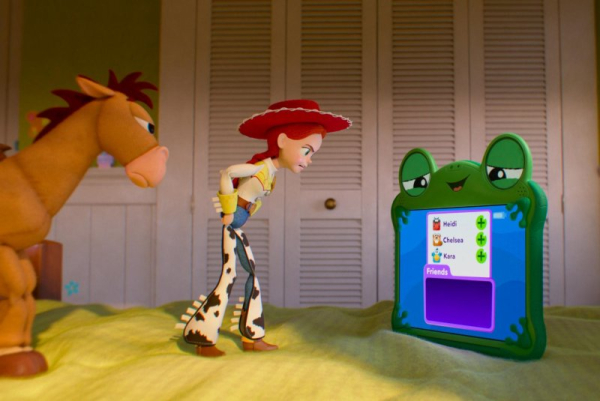
1 of 6 | Jessie battles Lilypad for Bonnie’s attention in “Toy Story 5,” in theaters Friday. Photo courtesy of Disney/Pixar
Toy Story 5, in theaters Friday, is about technology encroaching on play time but specifically about how that impairs real-life friendships. Toys are no longer simply the vehicle for children’s imagination, but also interpersonal connection.
Bonnie (Scarlett Spears) is too shy to ask the neighbors to play with her. Her parents reluctantly buy her a LilyPad tablet (Greta Lee), which the company nefariously sells as a way to make friends.
Toy Story 5 shows how kids zone out on screens, but also their parents do too. Jessie (Joan Cusack) is the toy leading the charge to find Bonnie a human friend who will actually play with her rather than sit together staring at their screens.
It is nice to see this sequel focus on Jessie, who was introduced in Toy Story 2. Woody (Tom Hanks) and Buzz Lightyear (Tim Allen) become supporting characters for her, the way ensembles should focus with sharing the focus in each entry.
Toy Story 5 also leverages the capital earned by Toy Story 2, arguably the most emotional entry in the franchise and perhaps in cinema history. Some would argue for Toy Story 3, and for an even more devastating animated film, Robot Dreams is streaming on Disney+ and Hulu.
Jessie has some flashbacks to her original owner Emily, whose outgrowing of Jessie traumatized her in 2. She’s now seen Andy grow up and give his toys to Bonnie, and now sees technology hastening Bonnie’s development, but removing the healthy steps of growing up.
Lily says she’s helping Bonnie make friends by connecting her with other LilyPad users from her dance class. That just exposes Bonnie to another group who can ostracize her.
Even Lily feels guilty about that eventually, so Pixar has hope that even tech thinks we’re misusing it. Toy Story 5 shows tech making kids outgrow toys faster, but without accruing the maturity or social skills they need as adults.
No wonder an open-hearted child can’t connect with the tablet crowd. The tech users are like a cult or Body Snatchers pod people. When Bonnie asks, “Why won’t anyone be my friend?” it may be blatant, but it’s universal.
Bonnie’s parents are responsible. They talk about limiting screen time and they are present when Bonnie is upset. Bonnie struggles to share with them as kids do, but Toy Story 5 really portrays ideal parental attentiveness without micromanaging.
Another subplot has a shipping crate full of Buzz Lightyear toys make their way back to town. This re-establishes the rules they learn, that they freeze every time a human sees them, and they re-learn original Buzz’s arc that he’s not actually a Star Commander but a toy.
Jessie gets returned to the address still written on her leg. A new family lives in Emily’s house and Jessie gets to deal with how her familiar surroundings changed with a new child.
She also meets phase one tech that has also been abandoned for the updated models. So even devices will be outgrown either by aging kids or newer models.
Returning to Emily’s house runs the danger of retconning the bittersweet closure of Toy Story 2. Fortunately, Toy Story 5 doesn’t negate that Emily did grow up and donate Jessie, but offers rewarding developments that deepen that without invalidating what Jessie experienced.
Pixar continues to evolve their visual aesthetic beautifully. Bonnie’s playtime with the toys are animated in a watercolor aesthetic. Her LilyPad screen is reflected in her eyeballs.
There are still jokes about the Toy Story lore, like the new Buzzes learning about Zurg all over again. A Bambi homage also suggests tech addicts should “touch grass” as it were.
The encroachment of technology might date Toy Story 5 in this decade more than the more universal earlier entries, and hopefully it becomes an issue of the past. Until then, we won’t have to wait long for Toy Story 6 to address the toys dealing with AI.
Fred Topel, who attended film school at Ithaca College, is a UPI entertainment writer based in Los Angeles. He has been a professional film critic since 1999, a Rotten Tomatoes critic since 2001, and a member of the Television Critics Association since 2012 and the Critics Choice Association since 2023. Read more of his work in Entertainment.
