


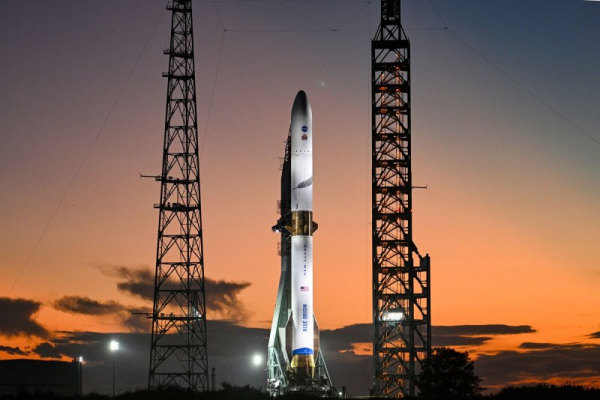
1 of 2 | Blue Origin’s New Glenn rocket, carrying a pair of NASA’s ESCAPADE spacecraft, sits on the launchpad at Cape Canaveral Space Force Station in Florida on Saturday. Photo by Joe Marino/UPI | License Photo
Private space company Blue Origin canceled Wednesday’s planned Mars-bound launch from Florida of its ESCAPADE craft for the second time due to increased solar flare activity.
The second delay came as a result of the strongest solar flares of the year Tuesday.
Blue Origin had planned its New Glenn rocket launch for 2:50 p.m. EST via its launchpad at Cape Canaveral Space Force Station in Florida. The rocket was expected to send NASA’s twin ESCAPADE orbiter devices to Mars.
“Due to highly elevated solar activity and its potential effects on the ESCAPADE spacecraft, NASA is postponing launch until space weather conditions improve,” Blue Origin officials said on X.
The launch of the company’s second New Glenn rocket was scrubbed minutes before liftoff after two holds.
The New Glenn rocket passed a key flight test in January.
A new launch date has yet to be announced, according to Blue Origin.
“We are currently assessing opportunities to establish our next launch window based on forecasted space weather and range availability,” the company wrote.
Dispatches from Mars: Perseverance rover sends images

NASA’s Perseverance Mars rover, using its Mastcam-Z camera system, captured this view of the Martian sunset on November 9, 2021, the 257th Martian day, or sol, of the mission. Martian sunsets typically stand out for their distinctive blue color as fine dust in the atmosphere permits blue light to penetrate the atmosphere more efficiently than colors with longer wavelengths. But this sunset looks different: Less dust in the atmosphere resulted in a more muted color than average. The color has been calibrated and white-balanced to remove camera artifacts. Photo courtesy of NASA | License Photo
