



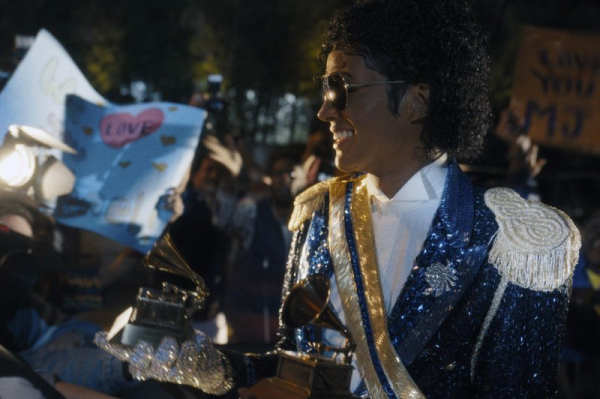
1 of 5 | Jaafar Jackson plays Michael Jackson in “Michael,” in theaters Friday. Photo courtesy of Lionsgate
Michael, in theaters Friday, is far from the first musician biopic to use familiar shortcuts and cliches to chronicle an artist’s life and career. However, those cliches have gotten a lot funnier to notice since Walk Hard: The Dewey Cox Story parodied them in 2007.
The film speeds through the Jackson family from their Gary, Ind., origins in 1966 through the ’80s. Joseph Jackson (Colman Domingo) turns his sons into The Jackson 5, with young Michael (Juliano Valdi) as the lead singer.
By 1978, Jaafar Jackson plays Michael as he embarks on a solo career, but needs the executives at Epic Records to tell his father for him. Montages depict his rise as one mail truck of fan letters grows to four, and record label executives toast his platinum albums.
Early scenes show Michael Jackson accumulating more and more exotic pets, from a rat to a llama, giraffe and Bubbles the chimpanzee. He says they’re not just pets, they’re his friends.
Young Michael also reads Peter Pan by flashlight and sees Captain Hook as Joseph. He calls his fans part of his family too, so it is clear he is desperate for a real connection that his childhood in show business never afforded him.
Plastic surgery is addressed in exactly one scene in which the doctor calls Michael handsome and asks if he’s sure he wants to change it. Joseph had called him “big nose” once as a child, but Michael says he wants his face to be symmetrical in pictures.
A movie need not fully explore the psychology that motivated more than one cosmetic procedure throughout his life. Still, a doctor advising his client against it, then saying, “Okay, whatever you want” is not a real scene, let alone a real human interaction.
Michael also comes home with his bandages on, where Joseph learns for the first time his son had the procedure. So, apparently, it was outpatient rhinoplasty too.
Inspiration for hit songs is also reduced to movie shorthand. A news report about the Crips and Bloods inspires “Beat It,” for which Michael Jackson did actually hire rival gang members as dancers for the music video.
Old horror movies like The Fly, Night of the Living Dead and House of Wax inspire “Thriller,” which is more fair as that song and video are directly horror-inspired and cast Wax’s Vincent Price. Still, it’s hard not to think of Dewey Cox finding inspiration for every song in a single moment of life.
The most egregious simplification is a single scene that addresses Michael Jackson wanting “Thriller” played on MTV. The network’s early resistance to Black artists is significant enough that a whole film should be devoted to breaking down that wall, which is one of the biopic issues Walk Hard spoofed.
An artist like Michael Jackson had so many achievements that it is misguided to try to include every single one in two hours. More successful biopics narrow the focus.
What’s Love Got to Do With It focused on Tina Turner escaping her abusive marriage but claiming her married name. Bohemian Rhapsody took heat for its timeline, too, but at least it focused on Freddie Mercury’s irreverent sense of humor.
The film does show Joseph Jackson to be physically abusive and opportunistic with his children’s careers. His wife, Katherine (Nia Long), gets to stand up to him in one scene, which is constructed as an applause moment that belies that real victories in abusive dynamics aren’t that easily won.
However, the script by John Logan never has Michael confront his father directly. He uses his platform on a concert stage to take back control, but it is absurd to have a movie where the protagonist never even directly overcomes his oppressor.
If that never happened in real life, that is one moment that should be artificially constructed for a movie. The audience needs to see Michael Jackson himself claim his individuality.
Michael shows very little of his songwriting process, only fragments of lyrics and titles on a bulletin board. There is a little bit more of Michael Jackson developing choreography in the studio, but only a handful of scenes.
He wears iconic costumes like the red leather jacket and blue military jacket when the film hits the right year. The timeline only slows down a bit when he’s making Thriller.
Ending in 1988, the film suggests a sequel following his next 21 years. There is certainly more to his story, but no reason to expect it would be handled with any more nuance.
This film does lay the groundwork for issues that could be further explored. After his Pepsi commercial burn incident, Michael Jackson began taking pain medication which would ultimately be the cause of his death.
Michael keeps talking about giving back to children and focusing on Neverland in his Peter Pan book. This film does not address any of the allegations surrounding Neverland Ranch, though Variety reported that earlier cuts of the film did.
The film serves as an explainer for new fans, if there are any born after his 2009 death who never heard this music. For the fans it’s a remake.
Antoine Fuqua directs an accurate remake, but just re-enacts songs, appearances and events with no reinterpretation. Good soundtrack, though.
Fred Topel, who attended film school at Ithaca College, is a UPI entertainment writer based in Los Angeles. He has been a professional film critic since 1999, a Rotten Tomatoes critic since 2001, and a member of the Television Critics Association since 2012 and the Critics Choice Association since 2023. Read more of his work in Entertainment.
Remembering Michael Jackson
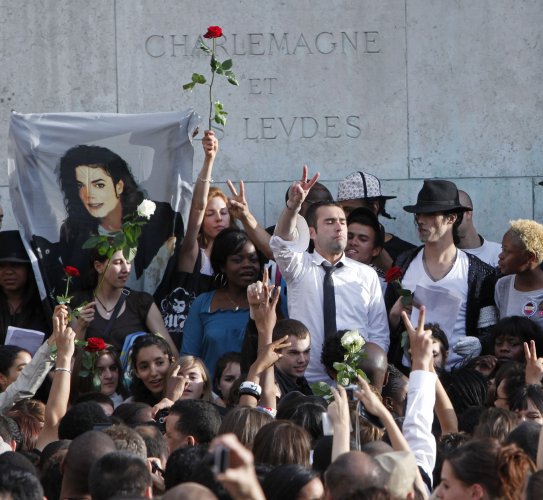
A crowd salutes deceased singer Michael Jackson during a spontaneous tribute in front of Notre Dame Cathedral in Paris on June 26, 2009. (UPI Photo/David Silpa) | License Photo
